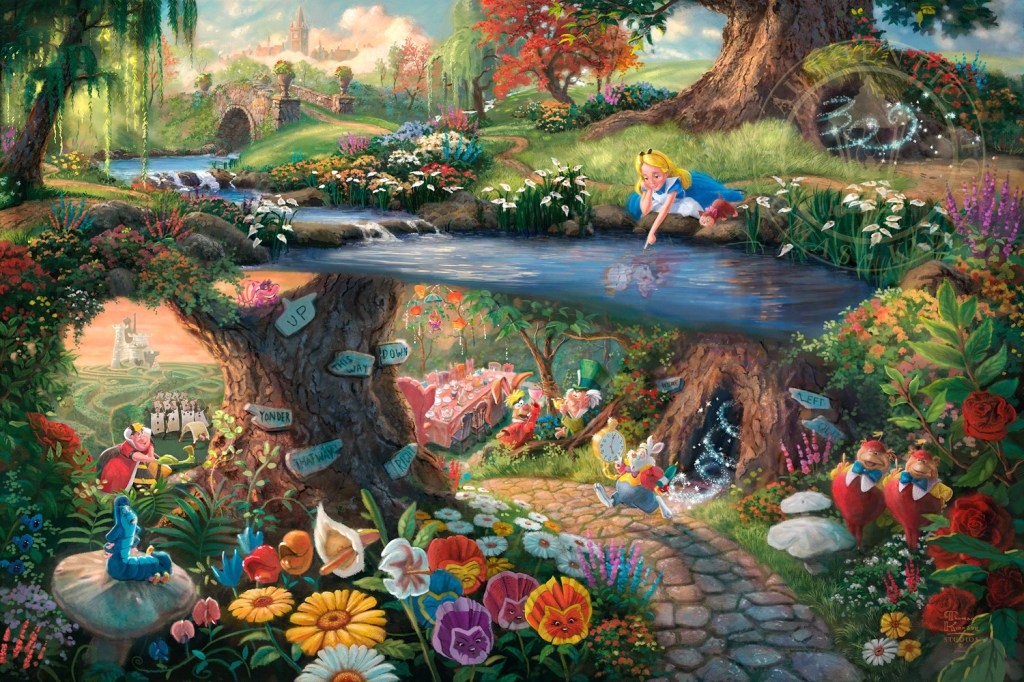
Falling into a rabbit-hole might be considered as an exciting, yet frightening event, but that’s not the only frightening event that occurred in Alice’s life. Alice comes across peculiar adventures and explores a new world in Lewis Carroll’s book Alice in Wonderland, also known as Alice’s adventures in Wonderland.
First impression and writing style
When I was reading the book, I noticed that the book is not written in the 2000s. Carroll uses a more difficult range of vocabulary than we are used to for children’s books. This suggests that children in the 1800s had another vocabulary. I was surprised, because I expected a simpler book. I knew beforehand that this book is a children’s book, which surprised me. Also, because Appleyard (1991) wrote: “Children’s books have uncomplicated sentences.”
“Yes, that’s about the right distance – but then I wonder what Latitude or Longitude I’ve got to?” (Carroll, 1865. p. 5)
The quote shows that the reader needs an advanced vocabulary in order to understand what is said. Arguably, the book could have been written more easily, since this is a children’s book.
I noticed the theme of the week, innocence, when I was reading the book. Alice comes across situations, which she handles exactly the same way. She responds to situations with questions, showing curiosity (innocence) and braveness. Look at this quote, in which Alice talks with a mouse:
“Oh I beg your pardon!” cried Alice hastily, afraid that she had hurt the poor animal’s feelings. “I quite forgot you didn’t like cats.” (Carroll, 1865, p. 25)
Final impression
After reading the book, I found it confusing and incoherent. Firstly, the incoherency chapters. For example, the chapter ‘The Queen’s Croquet-Ground’ (Carroll, 1865, p. 112). At the end of the book, a trial takes place. This happens in the chapter ‘Alice’s evidence’ (Carroll, 1865, p. 176). Alice participates in the trial, and she grows taller and taller. All the events that happened in the book do not have any relation to each other. It feels like Carroll had a lot of imagination and wanted to add everything to the book.
At some point, the difference between the Duchess and the Queen was not clear. In the group discussion it appeared that I was not the only one who was confused by both the events and characters.
Carroll did a great job in incorporating ‘innocence’ in the book. Even at the end of the book Alice makes innocent remarks. In the following quote Alice names everything trial-related in the room. Innocence shows, because Alice does not see the seriousness of the situation.
“She said this last word [jurors] two or three times over to herself being rather proud of it: for she thought, and rightly too, that very few little girls of her age knew the meaning of it all.” (Carroll, 1865, p. 164)
Role of parents
Alice’s parents are not present in the book. According to Appleyard (1991) this is because ”family issues are not the subject of the books children ages 7 to 12 read; the heroes and heroines of these books have to be at least psychologically parentless if they are to be convincing models of world mastery”. This is the case in Carroll’s book. We discussed that Alice has no parents, and if they were present, they wouldn’t have made a difference to the story. It is all about Alice’s adventures.
Patterns
Carroll uses songs and poems throughout the book, which is a pattern. Carroll could have done this, because the book is a children’s book and the songs could function as a lullaby. In my opinion, the songs and poems do not add value to the story. Look at this fragment:
“You are old, father William,” the young man said,
“And your hair has become very white;
And yet you incessantly stand on your hear
Do you think, at your age, it is right?” (Carroll, 1865, p. 63)
This is random and not necessary, as we discussed. Besides this fragment, Carroll has written various songs and poems, which all do not make sense in the story. However, there is one explanation for its use: “In the Victorian Era children had to learn many moralizing poems by heart. Carroll altered some of these (once very familiar) verses for the Alice books. Unfortunately, these poems are hardly remembered nowadays, so the fun of the parody has disappeared for the greater part (De Rooy, 2015).” This explains why the poems do not add anything to the book.
Plot
When reading Alice in Wonderland, it seems that the story is all plot. Appleyard (1991) writes: “The stories children tell are basically all plot, yet it is the complete story.” This explains why Alice in Wonderland is all plot. In the group discussion we concluded that Carroll’s book is all plot simply to match to the world of the children. This will motivate them to read.
Character
Alice is a curious and innocent girl, which is immediately noticeable. We know that, because Alice constantly asks questions. Appleyard (1991) mentions that: “Characters are what they do. For example: Nancy’s eyes sparkled with interest.” In the discussion we disagreed with Appleyard, since you have to deduct Alice’s personality. Carroll never mentions Alice’s innocence throughout the book, however, as readers we know by her actions. Erikson (1970) writes: “Children need to cope with new social and academic demands.” Alice does not meet Erikson’s statement about children Alice’s age, which makes Alice an unrelatable character.
Setting
We discussed that the setting is easy and not much described in the book. All the events happen in ‘Wonderland’. Appleyard (1991, p. 4) confirms this: Children’s books “have […] little description of people and settings.” This is exactly the case.
Age suitability
I would argue that this book is not suitable for children, because, firstly, the book does not meet this requirement stated by Appleyard (1991) : “Children’s books have uncomplicated sentences, short paragraphs, and little description of people and settings.” Carroll writes complicated sentences and uses difficult vocabulary. Secondly, in our discussion, we agreed that the events were too gruesome for children. Look at this quote:
“Behead that Dormouse! Turn that Dormouse out of court! Suppress him! Pinch him! Off with his whiskers!” (Carroll, 1865, p.175)
Another reason can be given for the inappropriacy. Erikson (1970) states, for children age six to eleven: “Children need to cope with new social and academic demands. Success leads to a sense of competence, while failure results in feelings of inferiority.” Since this is a difficult book for children, it will lead to failure, which is undesirable. Summarized, this book is not appropriate for children.
Alice in Wonderland may be a compelling story at first, however, when taking a closer look at it, it is not the great book you would expect. Alice in Wonderland should not be used in schools and is not even worth to be on reading lists. This is an example of how it should not be done.
(Word count: 750)
Bibliography
Appleyard, J.A. (1991). Becoming a Reader. Cambridge. Cambridge University Press
Carroll, L. (1998). Alice’s Adventures in Wonderland. Chicago, Illinois: VolumeOnePublishing.
De Rooy, L. (2015, December 22). Poem origins. Retrieved April 15, 2020, from http://www.alice-in-wonderland.net/resources/analysis/poem-origins/
Erikson, E.H. (1970). Reflections on the dissent of contemporary youth. International Journal of Psychoanalysis, 51, 11-22.
Thomas Kinkade Studios. (2019, April 1). Disney Alice in Wonderland | Thomas Kinkade Studios. [Photograph]. Retrieved February 21, 2020, from https://thomaskinkade.com/art/disneys-alice-in-wonderland/
 Stephanie's reading blog