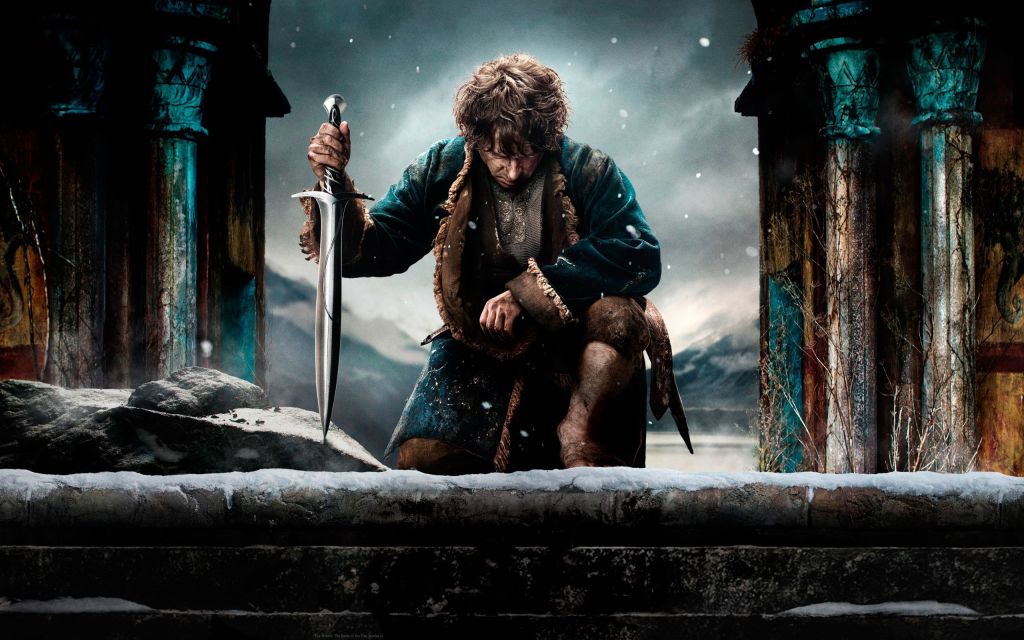
Bilbo Baggins, a hobbit, who is living a peaceful life at Bag-end, gets disturbed at one point. Thirteen dwarves invite themselves into Bilbo’s house to feast. This is where Bilbo’s story begins. The Hobbit is a story, written by J.R.R. Tolkien, which is about courage and taking back what is yours.
First impression and writing style
When I started reading the book, Tolkien begins with a chapter about runes. This immediately got me into the story. I personally love fantasy, which made me very excited to continue reading.
Despite my passion for Tolkien, I had two cons.
Firstly, Tolkien uses a lot of descriptions while writing. It feels like it is never-ending and unnecessary:
“In a hole in the ground there lived a hobbit. Not a nasty, dirty, wet hole, filled with the ends of worms and an oozy smell, nor yet a dry, bare, sandy hole with nothing in it to sit down on or to eat: it was a hobbit-hole, and that means comfort.” (Tolkien, 1937, p. 20)
I noticed that mainly in the beginning of the book, Tolkien uses descriptions this long. I can imagine readers stopping because of its lengthiness. I learned that these descriptions can easily be skipped to only reading the last sentence.
Secondly, I noticed that Tolkien uses old-fashioned words. This also made the book harder to read. In the first chapter Tolkien uses the word ‘throng’ in this sentence:
“Dwalin and Balin here already, I see,” said Kili. “Let us join the throng!” (Tolkien, 1937, p. 31)
I had to look up the word ‘throng’. This actually happened multiple times. In the group discussion I found out that I was not the only one with this problem. It could be that Tolkien uses these words, because he was a professor at Oxford, and therefore had a larger range of vocabulary.
Despite this range of vocabulary, Tolkien’s writing style is appropriate. Austin (2002, p.3) says this about the writing style of a good fantasy book: “The characters should speak in a way that is appropriate to their character and circumstances.” Tolkien does a great job at that, especially with Gollum:
“Bless us and splash us, my preciousss! I guess it’s a choice feast; at least a tasty morsel it’d make us, gollum!” (Tolkien, 1937, p. 128)
At the beginning of the book, the theme ‘escape’ showed, because the dwarves claim that they want to reclaim their home. They want to escape their current life to go back to their “normal” life.
Final impression
When I was done reading the book, I was disappointed. At the end of the book, a battle takes place. In the end, this event is the most important event in taking back the dwarves’ home. The battle does barely take half a chapter. That makes it feel too rushed.
However, the end of the book was great, because it gives the readers a reassuring feeling. It ends with a conversation between Gandalf and Bilbo:
“You are a very fine person Mr. Baggins, and I am very fond of you; but you are only quite a little fellow in a wide world after all!”
“Thanks goodness!” said Bilbo laughing, and handed him the tobacco-jar.” (Tolkien, 1937, p. 487).
Even at the end of the book ‘escape’ can be spotted. At the end of the book, Bilbo goes home, accompanied by Gandalf. I perceive this as his escape from the violent life that he has been living to his normal, ordinary, life.
Role of parents
In The Hobbit we do not know about Bilbo’s parents, only his ancestry to the Took family. Appleyard gives multiple answers on parentlessness. This one is particularly interesting: “One answer is that the mysterious birth-of-the-hero archetype so common in mythological literature has found its way into the common store of story-telling themes” (Appleyard, 1991). It is in fact true that the protagonists of most fantasy stories are parentless. We discussed Bilbo does not have parents, but Gandalf functions as his role-model. It is clear throughout the book that Bilbo looks up at Gandalf.
Patterns
We discussed that the patterns were the dwarves’ songs. We agreed that the songs could improve the feeling of brotherhood and processing of the happenings. We also discussed the songs could be Tolkien’s way of characterization, since they show the personality of the dwarves. Austin (2002) writes this about characterization, which proves my point: “Even the most elevated and fantastic story must possess a certain amount of emotional realism in the way it portrays its characters.” This allows the readers to identify with the characters (despite the fantasy). Appleyard (1991) writes that identification allows readers to sympathize.
“Far over the misty mountains cold
To dungeons deep and caverns cold
We must away, ere break of day
To claim our long-forgotten gold” (Tolkien, 1937, p. 40)
Plot
We discussed and agreed that the plot is clear, yet complicated. A lot of events happen in the book. Appleyard (1991) writes this about the complexity of a plot: “Perhaps the explanation is that genuine plot complexity is not a matter of subplots and flashbacks, but of the causal interrelationships between character and action.” Comparing this quote with The Hobbit, Appleyard is right. The Hobbit focuses on different races combined with action.
Character
Bilbo is an interesting character, because he develops tremendously in the book. He gains courage and he learns how to be tactful with his words. Look at this fragment from the book. It is between a spider in Mirkwood and Bilbo. Bilbo frightens the spider, by naming his sword:
“Go on! Go on!” Bilbo shouted. “I will do the stinging!” And he did. […]. The spiders swelled with rage, and spluttered and frothed, and hissed out horrible curses; but they had become mortally afraid of Sting, and dared not come very near, now that it had come back.” (Tolkien, 1937, p. 267)
We discussed that Bilbo allows teens to relate to him, because he is so well-developed. Erikson (1970) writes this: “Teens need to develop a sense of self and personal identity.” As Bilbo develops a lot in the story, this book can be useful to teens’ development.
Setting
The setting is very elaborate. Tolkien shows a drawing at the end of the book.
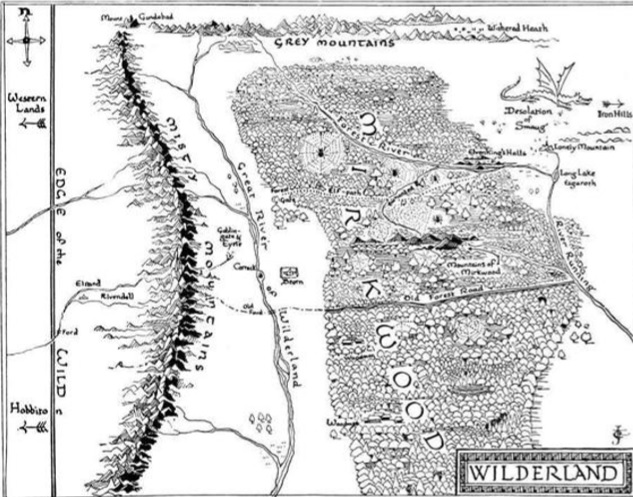
Austin (2002, p. 3) writes: “Epic fantasy can reasonably be expected to possess a distinctive setting.” This is definitely the case in The Hobbit. In the discussion we found out that we both loved the setting, because it is incredibly elaborate.
Age suitability
Looking at the vocabulary needed and the story, we came to the conclusion that this book is suitable for teens about sixteen-year-old. Erikson (1970) writes about teens: “Success leads to an ability to stay true to yourself, while failure leads to role confusion and a weak sense of self.” As this book is very educative, success is necessary. Appleyard (1991) writes: “Teens want a book which allows them to identify with characters and makes them think.” Since this book meets Appleyard’s and Erikson’s statements, the suitable age would be sixteen.
The Hobbit an amazing book, definitely one for reading lists, might be one of the best fantasy novels ever. It simply includes everything we want.
(Word count: 749)
Bibliography
Appleyard, J.A. (1991). Becoming a Reader. Cambridge. Cambridge University Press
Austin, A. (2002) Quality in Epic Fantasy. Retrieved April 15, 2020 from http://strangehorizons.com/non-fiction/articles/quality-in-epic-fantasy/
Erikson, E.H. (1970). Reflections on the dissent of contemporary youth. International Journal of Psychoanalysis, 51, 11-22.
Tolkien, J. R. R. (1937). The Hobbit. London, United Kingdom: HarperCollins.
WallpaperAccess. (n.d.). The Hobbit Wallpapers. Retrieved April 10, 2020, from https://wallpaperaccess.com/the-hobbit
 Stephanie's reading blog