
Wonder, a story written by R.J Palacio, is all about friendship and acceptance. Palacio wrote a book about a deformed boy, who goes to school for the first time ever. A page-turning and touching novel.
First impression and writing style
When I read the back cover of the book, I was excited to read this one. The story proved me right. When I started reading, I noticed the short chapters and the touching story. The story, about a deformed boy, immediately grabbed my attention. From chapter one Palacio allows you to sympathize with main character, August.
“My name is August, by the way. I won’t describe what I look like. Whatever you’re thinking, it’s probably worse.” (Palacio, 2012, p. 11)
This week’s theme is ‘first love’. When I began reading the book, I did not understand how this could be seen. However, when I was a little further, I realized that the theme ‘first love’, can also translate into ‘love by friendships’.
In my opinion, the theme really showed when Summer joined August at the lunch table. The way Summer expressed herself made me realize that this could be August first real friendship.
“Summer? August?” she said, smiling, her eyes wide open, as she waited for me to get it.
“Oh, yeah,” I said after a second.
“We can make this the ‘summer only’ lunch table,” she said.” (Palacio, 2012, p. 44)
The writing style was quite different from other young adult novels. The writing style in Wonder is simple. When looking at features of children’s books, Palacio’s book fits well. Appleyard (1991) writes this about the writing style in children’s books: “They have uncomplicated sentences and short paragraphs.” As you might have noticed in the quotes above, these two criteria are both applicable to Wonder.
Final impression
The ending of the book was touching, and it made me, as reader, feel so much happiness for August. Palacio has done a great job throughout her whole book. The features of a children’s book and the story, made this book a must read.
I also liked how the book ended when looking at the theme. As mentioned before, love translates to friendship in this book. At the end, August walks home together with Jack and Summer. They have been his true friends from the beginning until the end of the book, which is a wonderful translation of ‘first love’, namely ‘first true friendship’.
The last sentence of the book was wonderful as well. This is what August’s mum says to him:
“She bent down and whispered in my ear. “You really are a wonder, Auggie. Your are a wonder.” (Palacio, 2012, p. 213)
Role of parents
We discussed that the role of the parents is protection and encouragement towards August. Despite them being flat characters, they are the key to August’s happiness and confidence. They do not appear that much in the book, but they are present. Appleyard (1991) writes: “A good story makes young adults think. A good story keeps you reading and constantly.” Wonder makes you think, because of its great perspective of August. I believe that we can sympathize this much with August, because the other characters are more in the background. This explains why August’s parents are not as present as we would imagine.
Patterns
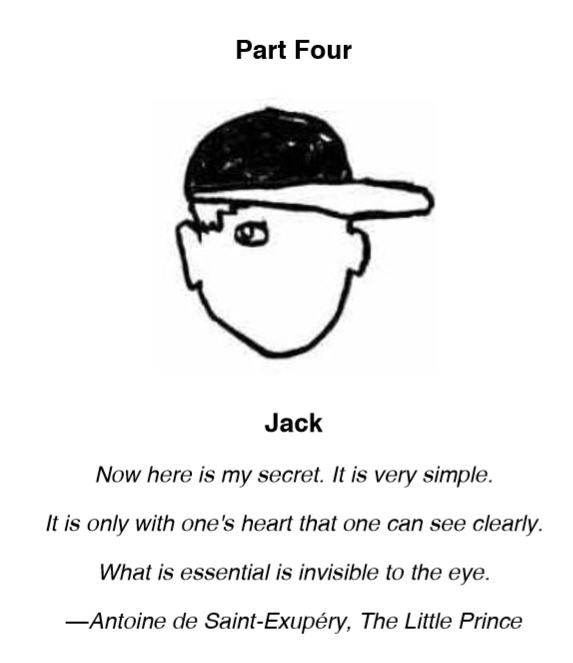
In our discussion, we agreed that the quotes at the beginning of a new perspective, are patterns. I believe these quotes add depth to a character other than August. I also believe that the quote displays the character’s view on people. As you can see, this displays Jack’s view of friendship. Appleyard (1991) gives this explanation, which is applicable to Wonder: “It does seem that one reason adolescents read biography and fiction is to imagine real lives to help them understand the possibilities in their own lives.” The quotes can thus be seen as a life lesson to readers.
Plot
We discussed and agreed that this book appears to be all plot. The story is all about August going to middle school. There is no such a thing as a climax, since all the events are basically plot. As mentioned before, this book consists features of a children’s book. Appleyard (1991) says: “Children’s stories appear to be all plot.” As the book was mainly about August going to high school, this theory is applicable to Wonder.
Character
We discussed that August might be seen as a simple character, yet he isn’t. August appears to be confident to other people, but he is, in fact, very insecure. He acts like nothing bad happened, while it actually did happen. In this quote he lies to his mother about Julian being nice, whilst he actually was mean to him:
“Were those kids not nice to you, Auggie?”
“Oh no,”I said, only half lying. “They were okay.” (Palacio, 2012, p.31)
Erikson (1970) writes: “Teens need to develop a sense of self and personal identity. As they make the transition from childhood to adulthood, they may begin to feel confused or insecure about themselves and how they fit in to society.” I believe that August is exploring the “new world” and how he fits into it, despite being deformed.
Setting
We discussed that the setting is fairly easy, simply middle school and August’s home. Most of the events happen at his middle school. Another feature of children’s books appears here. Appleyard (1991) writes: “Children’s books have little description of settings.” This is the case in Wonder. Palacio could have done this, because a middle school is a well-known, general setting.
Age suitability
In the discussion, we came to the conclusion that this book would be great for freshmen and on. Firstly, because of its writing style and children’s book features. Appleyard (1991) writes that children’s books have: “little description of setting, short and uncomplicated sentences and paragraphs.” Erikson (1970) writes this: “Teens need to develop a sense of self and personal identity. Success leads to an ability to stay true to yourself.” As Wonder teaches important life values about friendship, and because it is an easy book, it therefore is suitable for freshmen.
Wonder, an amazing book and a must-read for readers young and old.
(Word count: 748)
Bibliography
Appleyard, J.A. (1991). Becoming a Reader. Cambridge. Cambridge University Press
Erikson, E.H. (1970). Reflections on the dissent of contemporary youth. International Journal of Psychoanalysis, 51, 11-22.
Henley, A. (2017, December 21). Wonder is a feel-good movie that needed more realism. [Photograph]. Retrieved April 13, 2020, from https://www.theatlantic.com/entertainment/archive/2017/12/wonder-is-a-feel-good-movie-that-needed-more-realism/548828/
Palacio, R. J. (2012). Wonder. New York, United States: Alfred A. Knopf.
 Stephanie's reading blog