The Hunger Games

(Rijcken, 2015)

The Hunger Games, the first book of Suzanne Collins’ series, is all about survival. Participation in the Hunger Games simply means trying your utter best to survive. Katniss experiences all the hardships that you can think of related to The Hunger Games. She is trying to make the right choices, even though that is not always possible.

First impression and writing style

When you begin reading the book, you will immediately notice the first-person point of view. I personally really enjoy books with that point of view, because it allows you to get to know a character really well, in this case Katniss.

“When I wake up, the other side of the bed is cold.” (Collins, 2008, p.4)

I also liked Collins’ writing style. As I have mentioned, I like the point of view, but I also like the amount of descriptions Collins gives. It is just right.

“Sitting at Prim’s knees, guarding her, is the world’s ugliest cat. Mashed-in nose, half of one ear missing, eyes the color of rotting squash.” (Collins, 2008, p. 4)

Collins has a simple writing style, yet complicated. Collins generally uses well-known words. Sometimes she uses advanced words. These are features of young adult writing. Appleyard (1991) writes: “Children’s books have uncomplicated sentences, short paragraphs, and little description of people and settings.” As this is not the case in Collins’ book, this book can be seen as a great young adult novel.

The theme of the week is disillusion and disappointment. These were visible at the beginning of the book, because we get to know about Katniss’ hardships. Her life at home is tough, as she needs to work hard for food. It also shows when Prim gets chosen for The Hunger Games.

“There must have been some mistake. This can’t be happening. Prim was one slip of paper in thousands! Her chances of being chosen so remote that I’d not even bothered to worry about her. Hadn’t I done everything?” (Collins, 2008, p. 22)

Final impression

My first impression did not change. I enjoyed reading the book, although it took a little too long before the actual Hunger Games began. In my opinion it would have been better if the Hunger Games had started earlier. Definitely when you read about the Reaping, and then it takes a long time before something exciting happens again. I also liked the end, despite that it was an open ending. It does really encourage to read the second book.

The theme gained more depth when continuing the book, as it could be seen multiple times. I will highlight this one. Disappointment shows again when it is decided that the rule is yet again reversed, there is one winner. This means that either Katniss or Peeta has must die. This fragment shows the disappointment:

“There’s a small burst of static and then nothing more. I stare at Peeta in disbelief as the truth sinks in. They never tended to let us both live.” (Collins, 2008, p. 337)

Role of parents

We discussed that Katniss’ parents do not play a big role in The Hunger Games. Firstly, that’s because Katniss’ father died after an explosion. Katniss’ mom does not play a big role. I believe that Collins did this to emphasize Katniss’ story. Appleyard (1991) writes: “Most heroines are parentless in order to be convincing.” We discussed and agreed that Katniss’ mom is present, only to emphasize Katniss’ hardships.

Patterns

In our group discussion I found out that there are multiple patterns. Collins uses a lot of symbolism in her book. These are the most intriguing ones. The mockingjays, for example, symbolize defiance. Katniss’ mockingjay pin gives her strength, and the ability to “communicate” with the actual mockingjays, gives her strength.

Another symbol is the finger gesture. Katniss comes up with a special gesture, which can be seen as a symbol for rebellion. Ginny Wiehardt (2019) writes this about the importance of symbolism in fictive stories: “Symbolism takes something that is usually concrete and associates or affixes it to something else in order to give it a new and more significant meaning.” That is what Collins does.

Plot

We discussed that the plot is incredible. When looking at Freytag’s pyramid there is a clear exposition (introducing the characters), rising action (the Reaping and the Hunger Games), climax (fight between Katniss, Peeta and Cato)and falling action (getting back after their win) (Researchgate, 2019). The resolution is not clear, because there is a following book (Researchgate, 2019). All in all, Collins did a great job on the plot.

Character

When discussing the character, we found out that Katniss is a complicated character. She deals with a lot even though she is a teen. She has to make definite choices (life or death) and she also has a conflict about love. Erikson (1970) writes: “Teens need to develop a sense of self and personal identity.” This is what Katniss goes through. She defines herself through the choices.

Setting

In our group discussion we found out that the setting is simple, yet complicated. The story mainly takes place in the arena, the Capitol, and district 12. When taking a look at the bigger picture, Collins used another symbol. Panem symbolizes America.

“When I was younger, I scared my mother to death, the things I would blurt out about District 12, about the people who rule our country, Panem, from the far-off city called the Capitol.” (Collins, 2008, p. 7)

Appleyard (1991) writes: “A good story makes you think.” As the setting is a symbol, Collins proves that the setting is well-thought of.

Age suitability

This book is suitable for pupils from the age of 12. Appleyard (1991) states this: “The adolescents’ books deal with sex, death, sin, and prejudice.” As mortality is a part of the story, this book is suitable for this age group. Erikson (1970) writes: “Teens from the age of 12 need to develop a sense of self and personal identity.” As the book deals with Katniss developing her identity, it can be claimed from both Appleyard and Erikson’s view that this book is suitable for adolescents.

The Hunger Games is a great book to learn from. It is simple, yet complicated. Therefore, this book would make a great start of English at secondary schools.

(Word count: 750)

Bibliography

Appleyard, J.A. (1991). Becoming a Reader. Cambridge. Cambridge University Press

Collins, S. (2008). The Hunger Games. New York City, United States: Scholastic.

Erikson, E.H. (1970). Reflections on the dissent of contemporary youth. International Journal of Psychoanalysis, 51, 11-22. 

Researchgate. (2019, June 9). Freytag’s pyramid. Retrieved April 14, 2020, from https://researchgatesite.blogspot.com/2019/03/freytags-pyramid.html

Rijcken, R. (2015, February 18). Verwijderde scènes van The Hunger Games vrijgegeven nadat fans code kraken.[Photograph]. Retrieved April 14, 2020, from https://nl.metrotime.be/2015/02/18/must-read/verwijderde-scenes-van-the-hunger-games-vrijgegeven-nadat-fans-code-kraken/

Wiehardt, G. (2019, June 25). Symbolism in Fiction Writing. Retrieved April 15, 2020, from https://www.thebalancecareers.com/symbol-definition-fiction-writing-1277138
Click on ‘bibliography at the bottom-right to see all sources.

Wonder

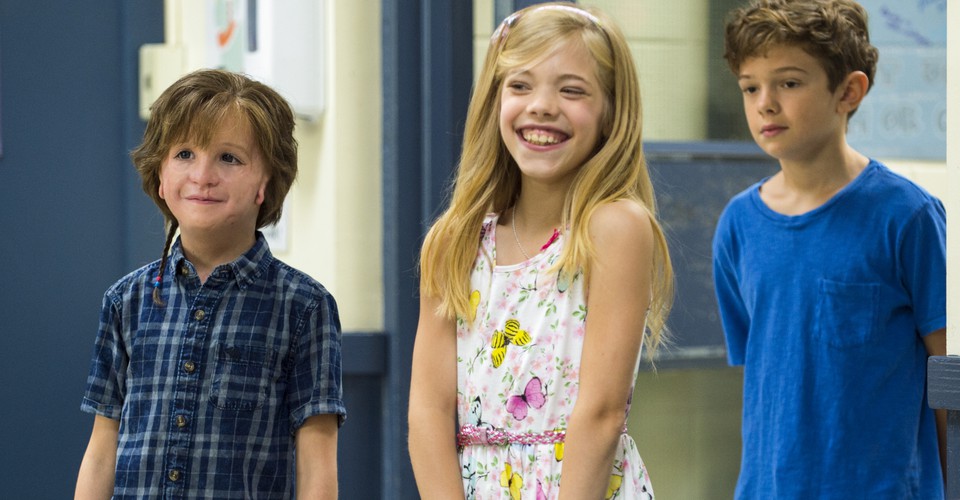
(Henley, 2017)

Wonder, a story written by R.J Palacio, is all about friendship and acceptance. Palacio wrote a book about a deformed boy, who goes to school for the first time ever. A page-turning and touching novel.

First impression and writing style

When I read the back cover of the book, I was excited to read this one. The story proved me right. When I started reading, I noticed the short chapters and the touching story. The story, about a deformed boy, immediately grabbed my attention. From chapter one Palacio allows you to sympathize with main character, August.

“My name is August, by the way. I won’t describe what I look like. Whatever you’re thinking, it’s probably worse.” (Palacio, 2012, p. 11)

This week’s theme is ‘first love’. When I began reading the book, I did not understand how this could be seen. However, when I was a little further, I realized that the theme ‘first love’, can also translate into ‘love by friendships’.

In my opinion, the theme really showed when Summer joined August at the lunch table. The way Summer expressed herself made me realize that this could be August first real friendship.

“Summer? August?” she said, smiling, her eyes wide open, as she waited for me to get it.

“Oh, yeah,” I said after a second.

“We can make this the ‘summer only’ lunch table,” she said.” (Palacio, 2012, p. 44)

The writing style was quite different from other young adult novels. The writing style in Wonder is simple. When looking at features of children’s books, Palacio’s book fits well. Appleyard (1991) writes this about the writing style in children’s books: “They have uncomplicated sentences and short paragraphs.” As you might have noticed in the quotes above, these two criteria are both applicable to Wonder.

Final impression

The ending of the book was touching, and it made me, as reader, feel so much happiness for August. Palacio has done a great job throughout her whole book. The features of a children’s book and the story, made this book a must read.

I also liked how the book ended when looking at the theme. As mentioned before, love translates to friendship in this book. At the end, August walks home together with Jack and Summer. They have been his true friends from the beginning until the end of the book, which is a wonderful translation of ‘first love’, namely ‘first true friendship’.

The last sentence of the book was wonderful as well. This is what August’s mum says to him:

“She bent down and whispered in my ear. “You really are a wonder, Auggie. Your are a wonder.” (Palacio, 2012, p. 213)

Role of parents

We discussed that the role of the parents is protection and encouragement towards August. Despite them being flat characters, they are the key to August’s happiness and confidence. They do not appear that much in the book, but they are present. Appleyard (1991) writes: “A good story makes young adults think. A good story keeps you reading and constantly.” Wonder makes you think, because of its great perspective of August. I believe that we can sympathize this much with August, because the other characters are more in the background. This explains why August’s parents are not as present as we would imagine.

Patterns

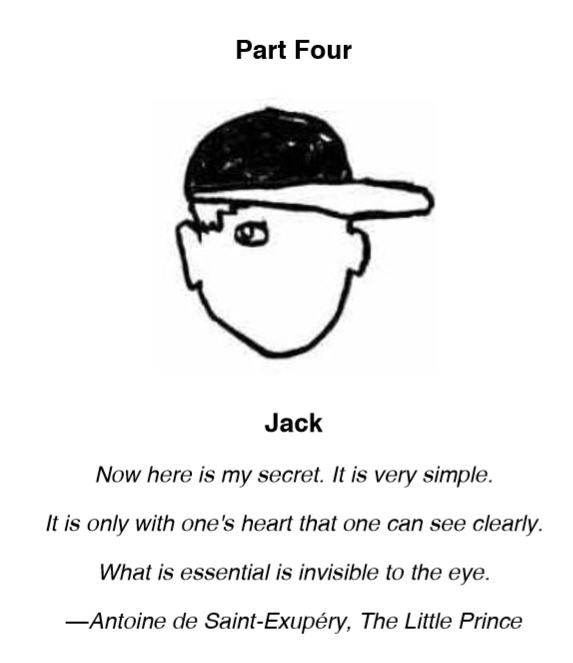
(Palacio, 2012, p. 97)

In our discussion, we agreed that the quotes at the beginning of a new perspective, are patterns. I believe these quotes add depth to a character other than August. I also believe that the quote displays the character’s view on people. As you can see, this displays Jack’s view of friendship. Appleyard (1991) gives this explanation, which is applicable to Wonder: “It does seem that one reason adolescents read biography and fiction is to imagine real lives to help them understand the possibilities in their own lives.” The quotes can thus be seen as a life lesson to readers.

Plot

We discussed and agreed that this book appears to be all plot. The story is all about August going to middle school. There is no such a thing as a climax, since all the events are basically plot. As mentioned before, this book consists features of a children’s book. Appleyard (1991) says: “Children’s stories appear to be all plot.” As the book was mainly about August going to high school, this theory is applicable to Wonder.

Character

We discussed that August might be seen as a simple character, yet he isn’t. August appears to be confident to other people, but he is, in fact, very insecure. He acts like nothing bad happened, while it actually did happen. In this quote he lies to his mother about Julian being nice, whilst he actually was mean to him:

“Were those kids not nice to you, Auggie?”

“Oh no,”I said, only half lying. “They were okay.” (Palacio, 2012, p.31)

Erikson (1970) writes: “Teens need to develop a sense of self and personal identity. As they make the transition from childhood to adulthood, they may begin to feel confused or insecure about themselves and how they fit in to society.” I believe that August is exploring the “new world” and how he fits into it, despite being deformed.

Setting

We discussed that the setting is fairly easy, simply middle school and August’s home. Most of the events happen at his middle school. Another feature of children’s books appears here. Appleyard (1991) writes: “Children’s books have little description of settings.” This is the case in Wonder. Palacio could have done this, because a middle school is a well-known, general setting.

Age suitability

In the discussion, we came to the conclusion that this book would be great for freshmen and on. Firstly, because of its writing style and children’s book features. Appleyard (1991) writes that children’s books have: “little description of setting, short and uncomplicated sentences and paragraphs.” Erikson (1970) writes this: “Teens need to develop a sense of self and personal identity. Success leads to an ability to stay true to yourself.” As Wonder teaches important life values about friendship, and because it is an easy book, it therefore is suitable for freshmen.

Wonder, an amazing book and a must-read for readers young and old.

(Word count: 748)

Bibliography

Appleyard, J.A. (1991). Becoming a Reader. Cambridge. Cambridge University Press

Erikson, E.H. (1970). Reflections on the dissent of contemporary youth. International Journal of Psychoanalysis, 51, 11-22. 

Henley, A. (2017, December 21). Wonder is a feel-good movie that needed more realism. [Photograph]. Retrieved April 13, 2020, from https://www.theatlantic.com/entertainment/archive/2017/12/wonder-is-a-feel-good-movie-that-needed-more-realism/548828/

Palacio, R. J. (2012). Wonder. New York, United States: Alfred A. Knopf.

Click on the button ‘bibliography’ at the bottom-right to see the complete bibliography

The Hobbit

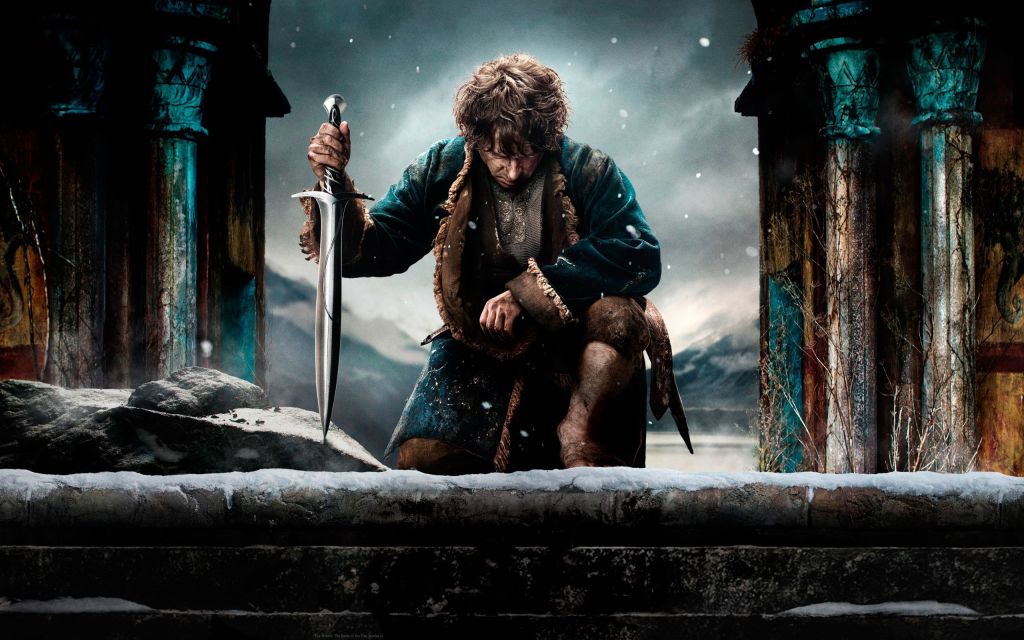
(WallpaperAcces, n.d.)

Bilbo Baggins, a hobbit, who is living a peaceful life at Bag-end, gets disturbed at one point. Thirteen dwarves invite themselves into Bilbo’s house to feast. This is where Bilbo’s story begins. The Hobbit is a story, written by J.R.R. Tolkien, which is about courage and taking back what is yours.

First impression and writing style

When I started reading the book, Tolkien begins with a chapter about runes. This immediately got me into the story. I personally love fantasy, which made me very excited to continue reading.

Despite my passion for Tolkien, I had two cons.

Firstly, Tolkien uses a lot of descriptions while writing. It feels like it is never-ending and unnecessary:

“In a hole in the ground there lived a hobbit. Not a nasty, dirty, wet hole, filled with the ends of worms and an oozy smell, nor yet a dry, bare, sandy hole with nothing in it to sit down on or to eat: it was a hobbit-hole, and that means comfort.” (Tolkien, 1937, p. 20)

I noticed that mainly in the beginning of the book, Tolkien uses descriptions this long. I can imagine readers stopping because of its lengthiness. I learned that these descriptions can easily be skipped to only reading the last sentence.

Secondly, I noticed that Tolkien uses old-fashioned words. This also made the book harder to read. In the first chapter Tolkien uses the word ‘throng’ in this sentence:

“Dwalin and Balin here already, I see,” said Kili. “Let us join the throng!” (Tolkien, 1937, p. 31)

I had to look up the word ‘throng’. This actually happened multiple times. In the group discussion I found out that I was not the only one with this problem. It could be that Tolkien uses these words, because he was a professor at Oxford, and therefore had a larger range of vocabulary.

Despite this range of vocabulary, Tolkien’s writing style is appropriate. Austin (2002, p.3) says this about the writing style of a good fantasy book: “The characters should speak in a way that is appropriate to their character and circumstances.” Tolkien does a great job at that, especially with Gollum:

“Bless us and splash us, my preciousss! I guess it’s a choice feast; at least a tasty morsel it’d make us, gollum!” (Tolkien, 1937, p. 128)

At the beginning of the book, the theme ‘escape’ showed, because the dwarves claim that they want to reclaim their home. They want to escape their current life to go back to their “normal” life.

Final impression

When I was done reading the book, I was disappointed. At the end of the book, a battle takes place. In the end, this event is the most important event in taking back the dwarves’ home. The battle does barely take half a chapter. That makes it feel too rushed.

However, the end of the book was great, because it gives the readers a reassuring feeling. It ends with a conversation between Gandalf and Bilbo:

“You are a very fine person Mr. Baggins, and I am very fond of you; but you are only quite a little fellow in a wide world after all!”

“Thanks goodness!” said Bilbo laughing, and handed him the tobacco-jar.” (Tolkien, 1937, p. 487).

Even at the end of the book ‘escape’ can be spotted. At the end of the book, Bilbo goes home, accompanied by Gandalf. I perceive this as his escape from the violent life that he has been living to his normal, ordinary, life.

Role of parents

In The Hobbit we do not know about Bilbo’s parents, only his ancestry to the Took family. Appleyard gives multiple answers on parentlessness. This one is particularly interesting: “One answer is that the mysterious birth-of-the-hero archetype so common in mythological literature has found its way into the common store of story-telling themes” (Appleyard, 1991). It is in fact true that the protagonists of most fantasy stories are parentless. We discussed Bilbo does not have parents, but Gandalf functions as his role-model. It is clear throughout the book that Bilbo looks up at Gandalf.

Patterns

We discussed that the patterns were the dwarves’ songs. We agreed that the songs could improve the feeling of brotherhood and processing of the happenings. We also discussed the songs could be Tolkien’s way of characterization, since they show the personality of the dwarves. Austin (2002) writes this about characterization, which proves my point: “Even the most elevated and fantastic story must possess a certain amount of emotional realism in the way it portrays its characters.” This allows the readers to identify with the characters (despite the fantasy). Appleyard (1991) writes that identification allows readers to sympathize.

“Far over the misty mountains cold

To dungeons deep and caverns cold

We must away, ere break of day

To claim our long-forgotten gold” (Tolkien, 1937, p. 40)

Plot

We discussed and agreed that the plot is clear, yet complicated. A lot of events happen in the book. Appleyard (1991) writes this about the complexity of a plot: “Perhaps the explanation is that genuine plot complexity is not a matter of subplots and flashbacks, but of the causal interrelationships between character and action.” Comparing this quote with The Hobbit, Appleyard is right. The Hobbit focuses on different races combined with action.

Character

Bilbo is an interesting character, because he develops tremendously in the book. He gains courage and he learns how to be tactful with his words. Look at this fragment from the book. It is between a spider in Mirkwood and Bilbo. Bilbo frightens the spider, by naming his sword:

“Go on! Go on!” Bilbo shouted. “I will do the stinging!” And he did. […]. The spiders swelled with rage, and spluttered and frothed, and hissed out horrible curses; but they had become mortally afraid of Sting, and dared not come very near, now that it had come back.” (Tolkien, 1937, p. 267)

We discussed that Bilbo allows teens to relate to him, because he is so well-developed. Erikson (1970) writes this: “Teens need to develop a sense of self and personal identity.” As Bilbo develops a lot in the story, this book can be useful to teens’ development.

Setting

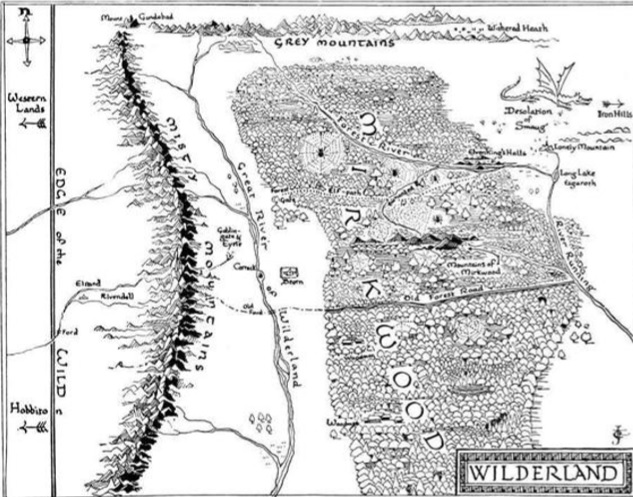
The setting is very elaborate. Tolkien shows a drawing at the end of the book.

(Tolkien, 1937, p. 488)

Austin (2002, p. 3) writes: “Epic fantasy can reasonably be expected to possess a distinctive setting.” This is definitely the case in The Hobbit. In the discussion we found out that we both loved the setting, because it is incredibly elaborate.

Age suitability

Looking at the vocabulary needed and the story, we came to the conclusion that this book is suitable for teens about sixteen-year-old. Erikson (1970) writes about teens: “Success leads to an ability to stay true to yourself, while failure leads to role confusion and a weak sense of self.” As this book is very educative, success is necessary. Appleyard (1991) writes: “Teens want a book which allows them to identify with characters and makes them think.” Since this book meets Appleyard’s and Erikson’s statements, the suitable age would be sixteen.

The Hobbit an amazing book, definitely one for reading lists, might be one of the best fantasy novels ever. It simply includes everything we want.

(Word count: 749)

Bibliography

Appleyard, J.A. (1991). Becoming a Reader. Cambridge. Cambridge University Press

Austin, A. (2002) Quality in Epic Fantasy. Retrieved April 15, 2020 from http://strangehorizons.com/non-fiction/articles/quality-in-epic-fantasy/

Erikson, E.H. (1970). Reflections on the dissent of contemporary youth. International Journal of Psychoanalysis, 51, 11-22. 

Tolkien, J. R. R. (1937). The Hobbit. London, United Kingdom: HarperCollins.

WallpaperAccess. (n.d.). The Hobbit Wallpapers. Retrieved April 10, 2020, from https://wallpaperaccess.com/the-hobbit

Click on the bibliography at the bottom-right

Alice in Wonderland

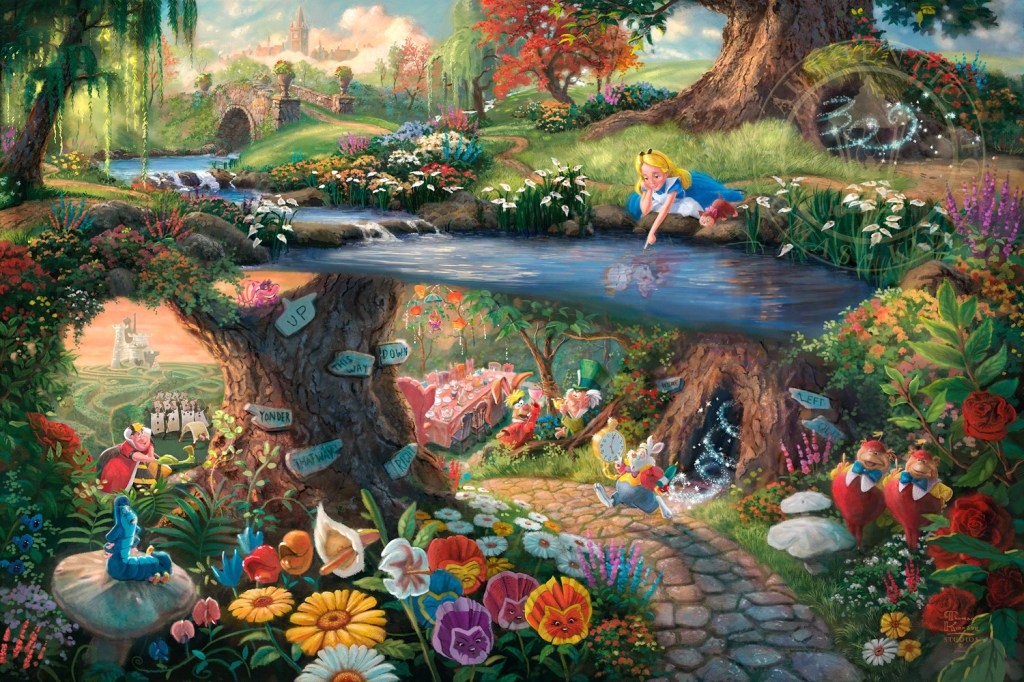
(Thomas Kinkade Studios, 2019)

Falling into a rabbit-hole might be considered as an exciting, yet frightening event, but that’s not the only frightening event that occurred in Alice’s life. Alice comes across peculiar adventures and explores a new world in Lewis Carroll’s book Alice in Wonderland, also known as Alice’s adventures in Wonderland.

First impression and writing style

When I was reading the book, I noticed that the book is not written in the 2000s. Carroll uses a more difficult range of vocabulary than we are used to for children’s books. This suggests that children in the 1800s had another vocabulary. I was surprised, because I expected a simpler book. I knew beforehand that this book is a children’s book, which surprised me. Also, because Appleyard (1991) wrote: “Children’s books have uncomplicated sentences.”

“Yes, that’s about the right distance – but then I wonder what Latitude or Longitude I’ve got to?” (Carroll, 1865. p. 5)

The quote shows that the reader needs an advanced vocabulary in order to understand what is said. Arguably, the book could have been written more easily, since this is a children’s book.

I noticed the theme of the week, innocence, when I was reading the book. Alice comes across situations, which she handles exactly the same way. She responds to situations with questions, showing curiosity (innocence) and braveness. Look at this quote, in which Alice talks with a mouse:

“Oh I beg your pardon!” cried Alice hastily, afraid that she had hurt the poor animal’s feelings. “I quite forgot you didn’t like cats.” (Carroll, 1865, p. 25)

Final impression

After reading the book, I found it confusing and incoherent. Firstly, the incoherency chapters. For example, the chapter ‘The Queen’s Croquet-Ground’ (Carroll, 1865, p. 112). At the end of the book, a trial takes place. This happens in the chapter ‘Alice’s evidence’ (Carroll, 1865, p. 176). Alice participates in the trial, and she grows taller and taller. All the events that happened in the book do not have any relation to each other. It feels like Carroll had a lot of imagination and wanted to add everything to the book.

At some point, the difference between the Duchess and the Queen was not clear. In the group discussion it appeared that I was not the only one who was confused by both the events and characters.

Carroll did a great job in incorporating ‘innocence’ in the book. Even at the end of the book Alice makes innocent remarks. In the following quote Alice names everything trial-related in the room. Innocence shows, because Alice does not see the seriousness of the situation.

She said this last word [jurors] two or three times over to herself being rather proud of it: for she thought, and rightly too, that very few little girls of her age knew the meaning of it all.” (Carroll, 1865, p. 164)

Role of parents

Alice’s parents are not present in the book. According to Appleyard (1991) this is because ”family issues are not the subject of the books children ages 7 to 12 read; the heroes and heroines of these books have to be at least psychologically parentless if they are to be convincing models of world mastery”. This is the case in Carroll’s book. We discussed that Alice has no parents, and if they were present, they wouldn’t have made a difference to the story. It is all about Alice’s adventures.

Patterns

Carroll uses songs and poems throughout the book, which is a pattern. Carroll could have done this, because the book is a children’s book and the songs could function as a lullaby. In my opinion, the songs and poems do not add value to the story. Look at this fragment:

“You are old, father William,” the young man said,

“And your hair has become very white;

And yet you incessantly stand on your hear

Do you think, at your age, it is right?” (Carroll, 1865, p. 63)

This is random and not necessary, as we discussed. Besides this fragment, Carroll has written various songs and poems, which all do not make sense in the story. However, there is one explanation for its use: “In the Victorian Era children had to learn many moralizing poems by heart. Carroll altered some of these (once very familiar) verses for the Alice books. Unfortunately, these poems are hardly remembered nowadays, so the fun of the parody has disappeared for the greater part (De Rooy, 2015).” This explains why the poems do not add anything to the book.

Plot

When reading Alice in Wonderland, it seems that the story is all plot. Appleyard (1991) writes: “The stories children tell are basically all plot, yet it is the complete story.” This explains why Alice in Wonderland is all plot. In the group discussion we concluded that Carroll’s book is all plot simply to match to the world of the children. This will motivate them to read.

Character

Alice is a curious and innocent girl, which is immediately noticeable. We know that, because Alice constantly asks questions. Appleyard (1991) mentions that: “Characters are what they do. For example: Nancy’s eyes sparkled with interest.” In the discussion we disagreed with Appleyard, since you have to deduct Alice’s personality. Carroll never mentions Alice’s innocence throughout the book, however, as readers we know by her actions. Erikson (1970) writes: “Children need to cope with new social and academic demands.” Alice does not meet Erikson’s statement about children Alice’s age, which makes Alice an unrelatable character.

Setting

We discussed that the setting is easy and not much described in the book. All the events happen in ‘Wonderland’. Appleyard (1991, p. 4) confirms this: Children’s books “have […] little description of people and settings.” This is exactly the case.

Age suitability

I would argue that this book is not suitable for children, because, firstly, the book does not meet this requirement stated by Appleyard (1991) : “Children’s books have uncomplicated sentences, short paragraphs, and little description of people and settings.” Carroll writes complicated sentences and uses difficult vocabulary. Secondly, in our discussion, we agreed that the events were too gruesome for children. Look at this quote:

“Behead that Dormouse! Turn that Dormouse out of court! Suppress him! Pinch him! Off with his whiskers!” (Carroll, 1865, p.175)

Another reason can be given for the inappropriacy. Erikson (1970) states, for children age six to eleven: “Children need to cope with new social and academic demands. Success leads to a sense of competence, while failure results in feelings of inferiority.” Since this is a difficult book for children, it will lead to failure, which is undesirable. Summarized, this book is not appropriate for children.

Alice in Wonderland may be a compelling story at first, however, when taking a closer look at it, it is not the great book you would expect. Alice in Wonderland should not be used in schools and is not even worth to be on reading lists. This is an example of how it should not be done.

(Word count: 750)

Bibliography

Appleyard, J.A. (1991). Becoming a Reader. Cambridge. Cambridge University Press

Carroll, L. (1998). Alice’s Adventures in Wonderland. Chicago, Illinois: VolumeOnePublishing.

De Rooy, L. (2015, December 22). Poem origins. Retrieved April 15, 2020, from http://www.alice-in-wonderland.net/resources/analysis/poem-origins/

Erikson, E.H. (1970). Reflections on the dissent of contemporary youth. International Journal of Psychoanalysis, 51, 11-22. 

Thomas Kinkade Studios. (2019, April 1). Disney Alice in Wonderland | Thomas Kinkade Studios. [Photograph]. Retrieved February 21, 2020, from https://thomaskinkade.com/art/disneys-alice-in-wonderland/

Click on bibliography at the bottom-right of the page to see all the sources.

Reading biography

My reading biography

From childhood on I started reading. I adored reading, I went to the library every week to take the maximum number of books with me, which was ten, at the time. I remember very clearly that I had a preference for ‘De Hondenclub’ books, which were books about a group of kids who had adventurous lives. The kids always took their dogs with them in order to face the challenge or adventure that laid ahead of them.

This great reading experience made me find reading an enjoyable time-spilling activity. As I grew older, I started to get preferences in certain books. When I was ‘’too old’’ for my childhood books, I enjoyed reading fantasy. I read less books in a week than before, since these books verged more attention. One example is Harry Potter. I almost slaughtered the books. This caused me to investigate more preferences.

Secondary school made me realize that I hate mandatory reading. It was definitely my most negative experience about reading. I realized that I didn’t like books all focused around non-fictive wars. I also realized that I do like reading books that have fictive wars in it, as in Tolkien’s books.

As of today, I really enjoy romantic books that are more or less fictive. I really enjoy reading books written by Holly Bourne and Anna Todd. Holly Bourne is known for her romantic books, in which the protagonists have a significant issue. In her book ‘Soulmates’ the protagonist suffers from panic attacks. Anna Todd is also known for her romantic series called ‘After’. What’s so special about Anna’s books is that there is a change of point of view, and the incredibly evident difference between the protagonists. Even though the protagonists differ a lot, they end up being together.

This whole reading experience made me realize that I have a preference for fictive fantasy books and somewhat realistic romantic books. It also made me realize that I do not enjoy reading a non-fictive book that is about a serious topic.

Bibliography

Wallpaper Safari. (n.d.). Library Books Wallpaper [Photograph]. Retrieved from https://wallpapersafari.com/w/K6dUwI

Click on the bibliography button at the bottom-right to see the whole bibliography

Design a site like this with WordPress.com
Get started